There’s a delicious irony creeping into the publishing world, and it’s getting harder to ignore.
Writers are now being told by publishers that their work may be run through AI detection tools to ensure they haven’t used AI.
Pause on that for a moment.
A human writes a book. The book is then fed into an AI to determine whether the human used AI to write it.
If that doesn’t make you smile, you may already be a machine.
Take the recent chatter around horror novel Shy Girl.
According to The Guardian, Hachette Book Group has withdrawn the book after allegations circulated online that its author, Mia Ballard, relied heavily on artificial intelligence. The book is to be discontinued in Britain after being published in November 2025, and its US launch date has been cancelled.
For those who missed it, the book became a talking point less for its plot than for the way it was written. Online discussions began circling around the idea that its prose felt “too perfect”— too evenly polished, too consistently structured.
From there, the leap was made: perhaps AI had been involved. Detection tools were mentioned, opinions gathered momentum, and soon the conversation wasn’t really about the novel at all. It was about authorship in the age of AI – how we recognise it, how we prove it, and whether we’re even asking the right questions.
And what are the telltale signs, apparently? Brace yourself: em dashes, similes, metaphors, and the Oxford comma.
In other words: writing.
Let’s be clear. These are not fingerprints of artificial intelligence. They are the tools of the trade. To suggest otherwise is like accusing a chef of cheating because they used salt.
I can still remember a teacher in Grade 7 patiently explaining metaphors to a room full of half-interested kids.
We were shown how one thing could stand in for another, how language could stretch, suggest and surprise.
None of it felt mechanical. It felt like learning how to think in colour instead of black and white. If that same lesson were delivered today, would someone raise a hand and say, “That sounds a bit AI”?
The truth is AI has been trained on vast amounts of human writing, so when it produces something polished, it inevitably echoes the rhythms and techniques real writers have used for centuries. The result? A strange feedback loop where human writing starts to look suspiciously like AI, because AI has learned to look suspiciously like humans.
And so we arrive at this peculiar moment in time: writers second-guessing their own instincts. Should I avoid that em dash? Is this metaphor too neat? Am I being… suspiciously articulate?
It would be funny if it weren’t so potentially stifling.
Because the danger isn’t that AI exists. The danger is that writers begin to contort their voices in an effort to sound “less like AI,” whatever that means. That way lies blandness. That way lies the death of style.
The smarter approach is to treat AI for what it actually is: a tool. A remarkably useful one, if handled with care. It can help brainstorm ideas, untangle clumsy sentences or offer a fresh angle when you’re stuck staring at the same paragraph for the tenth time. But it’s still the writer who decides what stays, what goes, and what matters.
And sometimes that means drawing a line.
“I can’t do that, AI Dave.”
Because the voice is still yours.
And that’s the part no detection tool can measure.
So yes, there’s irony in using AI to police AI. There’s irony in mistaking the hallmarks of good writing for signs of automation. But perhaps there’s also a quiet reassurance buried in all this.
If AI is mimicking us this well, it’s only because human writing was worth copying in the first place.
Em dashes and all.
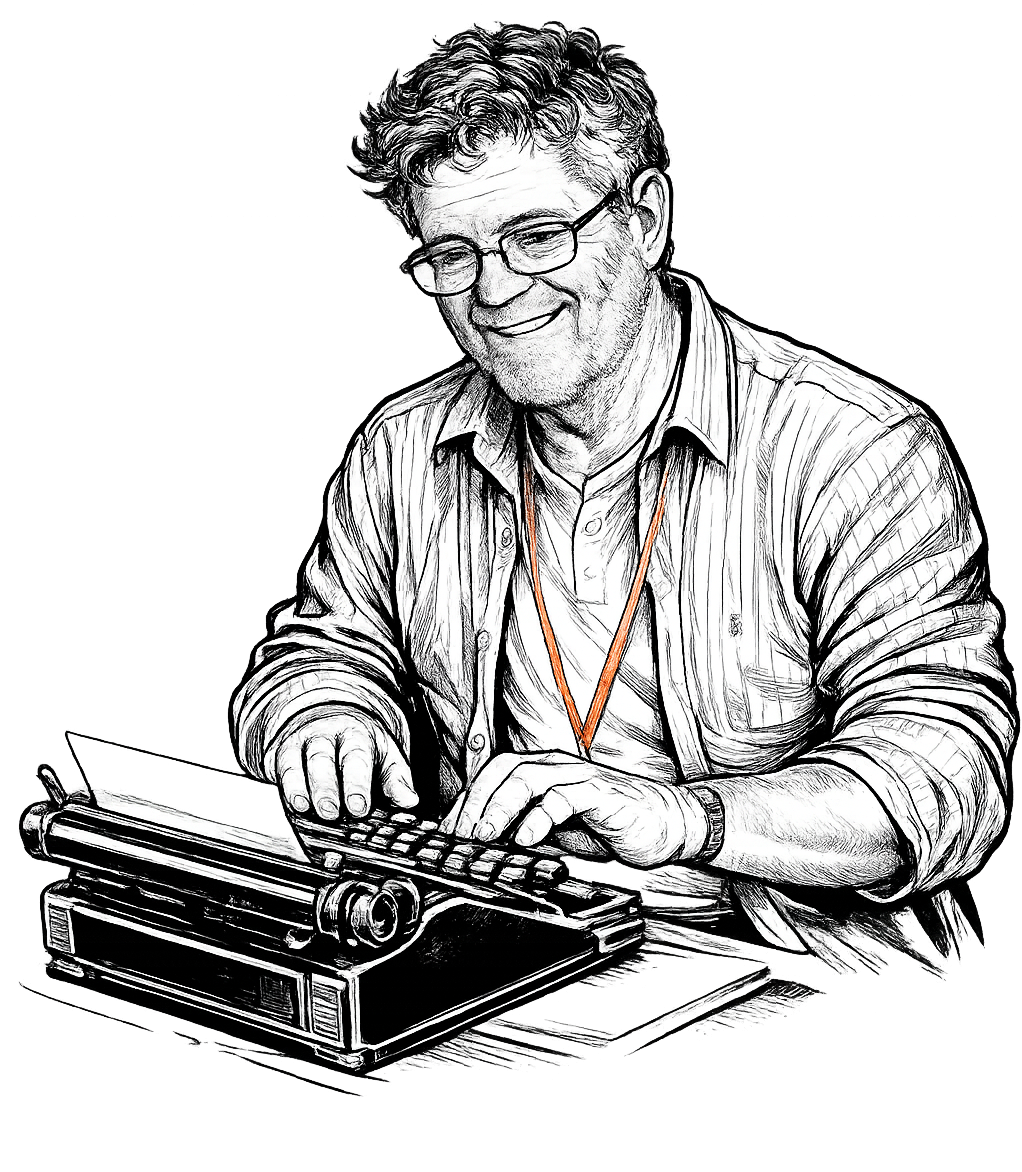
Footnote: Nearly every illustration on my website is AI-generated. I couldn’t subject readers to my stick men. I use it as a writing tool. But think of it this way: I used to work with a hammer and chisel. Now I have power tools.

 JOHN MARTIN'S TALES
Leave a comment