TRY BEFORE YOU BUY
CHAPTER 1
Billy wrestled his suitcase up the short flight of steps, expecting the motion detector to flood the porch with light. It didn’t.
It was past midnight, and the cold was biting.
He leaned over his suitcase and rang the bell, grateful for the faint illumination from the streetlight.
He turned at the sound of squealing tyres—Cedric Knightly’s taxi was pulling away from the kerb. Good riddance to the old bugger.
Billy pressed the button again.
The downstairs windows were dark, meaning the bar was closed. But light spilled from the upstairs rooms.
He rang a third time. Was it even connected? He couldn’t hear a thing. Shivering, he pounded on the door with his fist.
Finally, a dim light flicked on and the door opened. Rog, the publican, stood in the doorway, tying the cord of an old green dressing gown and blinking blearily.
“Did you forget something, François?” he said in a familiar raspy voice.
Billy stepped closer into the light. “No, it’s me—Billy. See?”
Rog squinted, scrutinising him like a suspect in a lineup. “Billy? Billy Gumboots? You’re still alive? We all thought you were long gone.”
“I’ve just been keeping my head down,” Billy said, blowing out a foggy breath. “Can I come in, mate?”
Rog blocked the doorway. “Why?”
“I’m freezing my knackers off out here.”
Rog raised a hand, palm out. “Sorry, we’re closed.”
“I don’t want a friggin’ drink—I just need a room.”
“We’re all booked out.”
“You’ve never been full before.”
“We’ve never had a Bastille Day convention before.”
“Bastille Day convention? Here? In Windy Mountain? You’re kidding.”
“Nope. Your brother organised it. You just missed him, by the way—I thought it was him at the door. Must’ve forgotten something.”
“Didn’t my beard give me away?”
“François’s grown a beard now, too. I reckon you two could pass as twins, though now my eyes are adjusted, I see your beard these days is, well . . . more creative.” Rog regarded him more closely. “Oh, and you’re wearing an earring, too.”
He started to turn away. “I’ll grab Cedric’s number.”
Billy grabbed his shoulder. “Hold on. Cedric just dropped me here. I’ve got a job interview next door first thing in the morning.”
“A job interview?” Rog’s face twisted. “At the Tasmanian Tiger Museum? Gawdsake.”
Billy puffed up his chest. “I’m going for the manager’s position.”
“Like that?” Rog shook his head slowly. “You can’t be serious.”
CHAPTER 2
Rog tightened his dressing gown. “Did Cedric mention the two other interviewees he brought here last week?”
Billy ran a hand through his hair. “No, he didn’t.”
“They came by for a counter meal—seemed all right.” Rog shrugged. “But maybe the Dutchman found them too squeaky clean.”
“The Dutchman?”
“Henk Van Gogh. If he’s the one interviewing you, watch your back.” Rog coughed nervously. “Cedric didn’t, um, mention that all our rooms are booked out, either, did he?”
“He might not have known.”
“Oh, he knew, all right. François had him pick up eight Francophiles from Launceston Airport and bring them here.”
Billy shook a fist. “Then why wouldn’t he have said something?”
“You know what Sir Cedric is like. He holds a grudge. Ever done anything to upset him?”
“Not that I remember,” Billy said slowly. Then he grimaced. “Well, he did go on in the car about how he blames me for the Tigers losing the ’93 grand final.”
Rog shook his head. “No, that can’t be it. Everyone blames you for that.”
“That’s not fair. There were 19 other blokes on that team.”
“Sure, but only the 20th man missed the goal that would’ve won the game.”
“Can we change the friggin’ subject? I just need some sleep if I’m going to ace that interview.”
“You’ll have to go to your mum’s place in Slutz Plains for that.”
Billy looked at his shoes and sighed. “I doubt Mamma’s ready for me turning up out of the blue yet.” He glanced up. “Why can’t I just kip on the back bar floor—for old times’ sake?”
Rog shook his head. “I could lose my licence if the inspectors do a spot check.”
“Oh, come on. They’re not coming at this time of the morning.”
“Easy for you to say. I’m only allowed eight paying guests—I even had to send your dad to stay with Oodles and Madge just to fit everyone in.”
“My dad?”
“Wish-Wash.”
Billy groaned. “Why does every man and his dog think that old bloke is my old man?”
“Hmm. Could it be you’re the same height, have the same type of snozzer, and you both sound like donkeys when you laugh?”
Rog let out a long breath. “Tell you what, Billy. Best I can do is lend you a blanket.”
He pointed into the darkness. “Take a shortcut past the skip. Round the side of the museum, you’ll find a shed where you can doss down.”
“A shed?”
Rog crossed his arms. “Take the blanket or leave it.”
CHAPTER 3
Billy looked down and swore. In the weak light, he saw why the shed door wouldn’t budge—a large combination padlock dangled from the latch.
Rog wouldn’t have known about that, but still. What had happened to the bloke? Rog used to be all about bending the rules. Back when Billy was 17—under-age, and Rog knew it—he’d served him cider in the back bar. Letting him crash on the bar-room floor wouldn’t have been a big deal back then.
Billy tried twisting the lock, hoping it might break loose. It rattled but held firm. After a few attempts with random combinations, he gave up.
He had no choice now.
He scoped out a patch of concrete partly under the eaves at the front of the main building. Rummaging in his suitcase, he pulled out his sheepskin coat and yellow-and-black footy beanie, then wrapped himself in the blanket.
The concrete was cold. It warmed beneath him, but not by much.
Sometime in the night, a cat wandered over and curled up beside him.
CHAPTER 4
Billy slept fitfully. When he was awake, he rehearsed his interview strategy; when he drifted off, he dreamed of everything that could go wrong. But nothing prepared him for the sharp kick in his ribs that jolted him awake.
“What the . . . ?” he shrieked, squinting up.
A figure loomed above him, backlit by the rising sun.
“I barely fugging touched you,” the man said, steam billowing from his mouth. “Serves you right for sleeping outside my front door.”
Billy sat up, shrugging off his dark-blue blanket. The man’s features sharpened. He was tall, thin, with a roll-neck jumper visible under a blue puffer jacket..
“Your front door?” Billy glanced around and saw his dim reflection in the tall windows along the front of the building. “I thought this was the Windy Mountain Tasmanian Tiger Museum.”
“It is. And I’m the regional manager—Henk Van Gogh.”
Billy rubbed his eyes. “Mr Van Gogh? You’re the man I’m here to see.”
“And you are?”
“Billy Kretocek. I’m here for the interview.”
“Dressed like that?” Van Gogh shook his head. “Is sleeping rough your usual approach for job interviews?”
Billy stretched, yawning. “Good thing you woke me before the frost dropped.” He patted the ground around him. “Where’s the cat?”
“You brought a fugging cat with you?”
“No, he’s not mine. He just showed up, meowing like he owned the place and wanted in.”
Van Gogh’s gaze narrowed. “What colour was it?”
“It was too dark to tell. All I know is, he curled up next to me and purred.”
“Godverdomme,” Van Gogh said. “Hope it’s not the same fugging cat the last manager had. I figured it’d gone feral—or starved, better still.”
“What’s your problem with cats?”
“I’m allergic. Especially to that one.” He held out a hand to help Billy up.
CHAPTER 5
Van Gogh unlocked the door and bounded into the dark. Billy followed more hesitantly, dragging his suitcase along.
The Dutchman struck a match, illuminating what looked like a counter. “There’s a candle here somewhere,” he muttered, disappearing through a small gate to the other side. “Ah, got it.”
Billy watched as Van Gogh lit the candle, the flickering flame casting shadows.
“No electricity?” Billy asked, glancing around. “If I’d known we were doing this interview by candlelight, I would’ve brought a bottle of wine.” He started hee-hawing at his own joke.
But Van Gogh shook his head slowly. “I’d heard you brayed like a donkey, but I didn’t realise how irritating it could be. Not a great start.”
Billy’s grin disappeared. “I didn’t know the interview had started.”
“It started the moment I found you sleeping on my doorstep like a vagrant.” Van Gogh sighed. “Why would we waste money on electricity when the place is closed?” He gestured towards the floor-to-ceiling windows at the front of the foyer. “We won’t even need the candle much longer anyway.”
Billy turned to look. Sure enough, the growing daylight was already stretching shadows of telegraph poles and a tree across the room.
When he turned back, Van Gogh’s eyes were fixed on him with disapproval. Feeling self-conscious, Billy yanked off his beanie, but the Dutchman’s glare remained unchanged.
“Oh, I get it,” Billy said quickly. “You don’t like the earring.”
“You guessed right.”
“I can explain. I fumbled around in the dark for my sleeper earring last night, but—”
“And the beads in your beard? What’s the story there? Did you escape from a circus?”
Van Gogh sneezed suddenly, and the candle’s flame flickered and bent.
“Bless you,” Billy said.
“Damn that cat,” Van Gogh said, wiping his nose.
“That’s harsh. He’s not even here.”
“No, but he’s been here.” Van Gogh’s nose twitched, and he sneezed again.
“Bless you again.” Billy hesitated. “Where can I wash up?”
Van Gogh pointed towards two doors across the foyer. ‘Take your pick—ladies or gents. Both are as pitch-black as the inside of a cow, and neither has running water. But at least you can do something about that fugging earring.”
CHAPTER 6
When Billy stepped out of the gents, the foyer was flooded with sunlight—so bright he had to shield his eyes.
Behind the counter, Van Gogh sat clutching a handkerchief. “Told you it’d brighten up fast.” He sneezed and cleared his throat. “Right,” he said, voice nasal. “Shall we get down to business?”
Billy sniffed as he crossed the room. “Is it just me, or is it starting to smell musty in here?”
Van Gogh waved a hand. “Spare me the commentary. I’ve cleared a space. Sit down.”
Billy straddled the stool, watching as Van Gogh lowered his head to study a notebook filled with scrawled notes that appeared to be upside-down Dutch.
The clock on the wall ticked loudly, even though it showed the wrong time.
Finally, Van Gogh looked up. His piercing blue eyes locked on to Billy. “I’ll be frank. You’re up against it at 41. We’ve already interviewed two excellent candidates—both younger, better qualified, more appropriately dressed and much more respectful.”
Billy straightened. “But do they have the advantage of local knowledge?” He paused, then blurted, “I also like cats, probably more than they do.”
Van Gogh’s eyes narrowed. “You don’t read people very well, do you?”
He flicked dramatically through his notes. “Frankly, you’re possibly the worst candidate I’ve ever interviewed. Certainly the scruffiest, the least qualified, and absolutely the only one who’s camped out on my doorstep like a bum.” He cleared his throat. “But you do have one thing we’re interested in—the only reason you made the shortlist.”
Billy frowned. “And that is?”
Van Gogh cleared his throat again, theatrically this time. “Is it true you know Moose Routley?”
Billy exhaled sharply, his brow furrowed. “Moose Routley? Moose Routley? Now, where have I heard that name?”
Van Gogh’s nostrils flared, his lips twitched, and he sneezed into his handkerchief. “You don’t remember? You shared a cell with him in Risdon Prison.”
Billy stiffened. “How do you know about that?”
“It’s my job to know.” Van Gogh glanced at his notes. “You even played football together.”
Billy felt heat rise to his face. “Look, I didn’t think it was relevant, all right? It was a long time ago. I’ve moved on.”
Van Gogh didn’t look up. “Yes, I see you’ve been in hiding for years. Why didn’t you even tell your family where you were?”
Billy’s jaw dropped. “How do you know all this?”
“Due diligence. Mr Biggs insists his employees are well prepared.”
“Mr Biggs?” Billy said.
“The owner of this company. He wanted you screened thoroughly.” Van Gogh’s nose twitched, and he sneezed again.
Billy frowned again. “But what’s Moose Routley got to do with this?”
Van Gogh’s eyes met his. “He’s exactly the kind of employee we want. What do you say?”
“Say?” Billy repeated, confused.
“Are you in touch with him?”
Billy hesitated. “Not really.”
“Do you know where he lives?”
“He might still be in prison, for all I know.”
Van Gogh shook his head. “He’s not. We checked.”
“He must have a parole officer?”
“Confidential information,” Van Gogh said.
Billy twisted a few strands of facial hair. “I suppose I could make some calls. He still hasn’t returned my football boots.”
“Good,” Van Gogh said, sneezing again. “That puts you ahead of the others. They were both highly qualified, but they thought we’d invest a lot of money. We’re not.”
“You’re not?”
Van Gogh shoved a clipboard at Billy, turning it around. “Sign here, please.”
Billy looked at the top sheet and realised it was the first of 22 pages. “What’s this?”
“Your employment contract.”
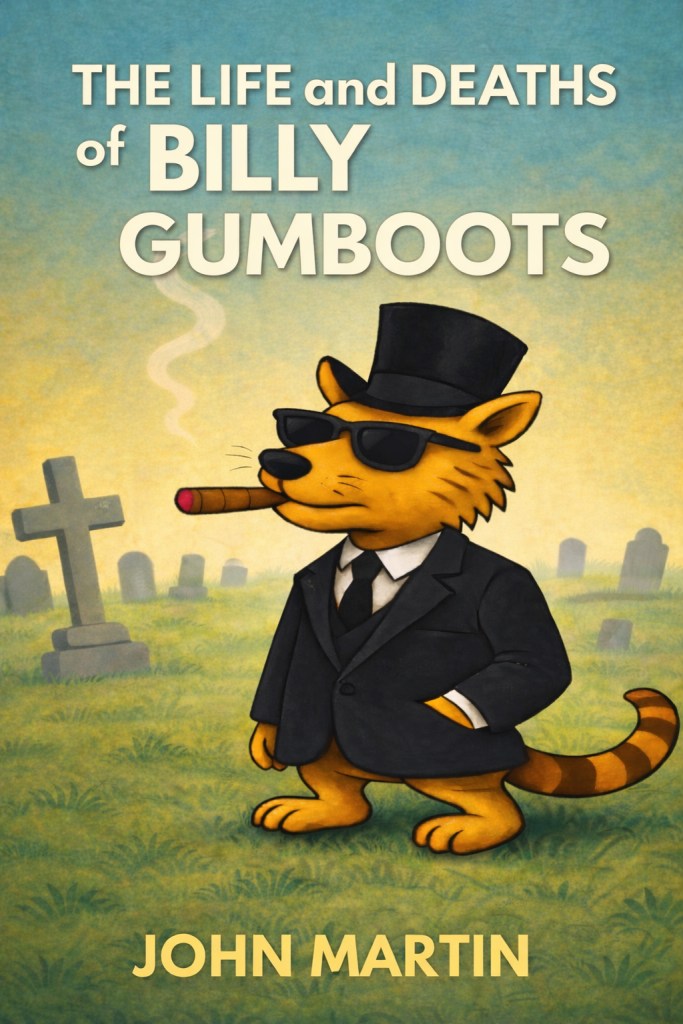
Enjoying this free preview? You can find the ebook on Amazon, Kobo, Apple Books or Barnes & Noble. If you prefer the smell of paper and ink, the paperbacks are on Amazon too.
 JOHN MARTIN'S TALES