TRY BEFORE YOU BUY
- PERVERT OF INTEREST
Sergeant Randolph Birtwistle wished now he hadn’t left the shelter of the bar at that precise time.
If he hadn’t been trying to beat the rain, he wouldn’t now be standing in front of the bench knowing full well who was sitting on the other side of that newspaper — but still feeling duty-bound to ask the question:
“Mr Mayor, is that you?”
Mayor James Northan lowered his rain-speckled newspaper. “So you are here, sergeant?”
Birty sighed. A few minutes earlier he had been warm and dry at the footy club, basking in the glory of a heart-stopping victory. But he had abandoned his glass of sarsaparilla when he saw dark clouds out the window of the bar.
It had been easier to make this 100-yard dash to the police station when he was younger and slimmer. The raindrops blurring his spectacles didn’t make it any easier this afternoon.
It’s a wonder he even noticed some idiot was sitting on the bench on the grassy verge in the middle of the High Street. But his reflexes got the better of him and he slid to a halt. By the time he took in the blue pin-stripe trousers, the shiny shoes and a masthead that told him the newspaper was The Financial Review, it was all too late.
“I’ve been trying to ring you all afternoon, sergeant.” Even when Mayor Northan was looking up at him he made Birty feel he was looking down at him. “Has any progress been made on the missing telephone box?”
Mayor Northan didn’t wait for a reply. “If you were more in touch with the community you’d know people use that phone box — old people especially.”
When Birty sat down, the dampness seeped through the back of his pants. He closed his eyes and counted in his head . . . one, two, three . . . his missus had ironed these trousers! He sighed again. “You didn’t get to the game?”
“I had better things to do.” Mayor Northan stabbed a finger at the newspaper. “I found an interesting article on windsocks.”
“More interesting than watching Windy Mountain win a place in the grand final? Moose Routley kicked the winning goal on the siren.”
The mayor curled his lip. “Oh, for heaven’s sake! That means I’ll have to talk to the players in front of half the town!”
“If it’s any consolation, I don’t think you’ll have to talk to Moose. Silly bugger got himself reported for punching an opponent.”
Birty stood and prised back his trousers. “Sorry, but I have to get going. This rain is getting heavier.” He could see beads of water on the mayor’s nose now. “I really have to get to work for my very last Saturday night shift. Sooner I start—“
“I thought you had months to go?” Mayor Northan’s eyes widened.
“No, only six more shifts. We’re booked on a cruise in 10 days’ time.” Birty removed his spectacles and wiped them with a hanky. “Rita’s been asking me to take her on a South Pacific holiday for years.”
“Don’t you think 60 is a bit young to be retiring? You’re only three years older than me! You’re not thinking about another career?”
Birty laughed as he put the glasses back on. “I’m planning on catching lots of trout.”
“Pity. I could do with someone like you to help me with my new project.” The mayor lowered his voice. “What would you say if I told you I’ve decided not to sell my orchard after all?”
“I’d say that would make a lot of people around here very happy.”
“Would it?” The Mayor smiled. “What I’ve decided to do now is hang on to the land, rip out the orchard and build a windsock factory on the site.”
“How’s that going to make things better?” Birty resumed his silent counting . . . five, six, seven . . . “That orchard is a part of the heritage of this town. People won’t let you tear it down.”
“I’ve obviously misjudged you, sergeant. You’re allowing sentimentality to muddle your mind.”
“Look, I’ve really gotta go, Mr Mayor. You’d better get some cover, too, before you catch your death.” With that wishful thought, Birty crossed the road.
* * *
Birtyheard Constable Smith and Junior Constable Stretch arrive about 6pm. Their boots squelched on the linoleum floor as they came down the hall.
Birty growled when he saw the trail of muddy footprints behind them when they came into the charge room. “I hope you young blokes haven’t been drinking?”
“Of course not, sarge,” Smithy said. “We only had a few lemonades to celebrate.”
Birty tried to ratchet up his grumpy look so Smithy wouldn’t be able to detect he shared his excitement. “Just as well I’ve decided to work one last Saturday, eh?”
“Thanks, sarge. I owe you.”
“Just win the premiership. Then you can retire from the game on a high note.”
Birty’s mentors had schooled him in the art of tough love, which is how come he tried hard not to give the impression he thought much of the football skills of young Smithy.
He had to admit Smithy was a darn good ruckman. But he’d reached the same fork in the road Birty had come to 35 years earlier.
They had already had THE talk.
“You have to make up your mind.” Birty tapped his index finger on Smithy’s chest. “Do you want to hang with the boys every Saturday afternoon or do you want to further your career with the Police Force? Because. You. Can’t. Do. Both.”
Birty couldn’t believe it was 1993 already. He had had his retirement date circled in his diary for years and now it was just about here. He had come to Windy Mountain nearly 40 years before as a junior constable. He had married a local girl and done his best to get involved in the community.
Most of the year Windy Mountain was a law-abiding little town, and Birty and Smithy didn’t have to raise much of a sweat.
Except for the missing telephone box, and the frequent, but peaceful, locking up of The Big O, a copper’s life around here was pretty quiet.
Smithy now had a new colleague. The idea was Smithy would step up to become station boss and Stretch would become his assistant. Stretch had never played football but Windy Mountain had already signed him for the next year on the thinking if he brought nothing else to the team at least he was big enough to get in his opponents’ way. Birty wondered how long it would be before Smithy was thumping his finger on Stretch’s chest during THE talk.
Then again, perhaps that would become a thing of the past. Policing had changed and he guessed it would continue to evolve. Birty remembered when it was quite acceptable for him to clip schoolboys under the ear if they were spotted smoking behind the change-room sheds at the Football Ground or caught nicking fruit from Northan’s orchard. And everyone turned a blind eye if bully and petty thief Freddy Cuthbert was brought from the cells with a black eye.
All this political correctness and sticking to the rule book had been coming for years. Smithy would probably cope. But he was still going to have to hang up his boots at age 24.
Birty actually welcomed the arrival of the muddy boots. Mopping the floor would be a welcome break from trying to tidy up all his paperwork. That’s another thing that bugged him these days. Were all these forms really necessary?
“You didn’t see the Mayor across the road when you came in?” Birty said.
Smithy scoffed. “Are you joking? It’s raining cats and dogs out there now!”
“You know the Mayor? He’s so full of himself he probably thinks he can command the weather to change.”
Smithy and Stretch wouldn’t have heard him. They had turned around and were headed to the urn.
“Hey,” Birty barked. “What do you think you’re doing?”
“We’re just making a drink, sarge.”
“This isn’t a blooming cafeteria! I want you two out on the street A.S.A.P. I don’t want any over-zealous spectators thinking they can misbehave in this town.”
Smithy looked at his watch. “You must have seen how many people were packed in the bar? If anyone’s managed to cut through and order more than four beers by now, I’d be surprised. No one will be unruly at this hour, especially in this weather.”
“Just do it, son, OK? When you’ve got your bum in this chair, you can do what you like. Right now . . . ” He pointed to the mug beside him. It said in big letters: THE BOSS.
Smithy and Stretch put on their raincoats and went out. At 11pm they made their first arrest. But this one was expected on a Saturday night. They carried The Big O in and deposited him in the cell.
* * *
He was filling in the final minutes of his shift by trying to come up with a name for The Pick Of The Crop’s cow when the front door slammed again.
Birty glanced up at the clock on the wall. It was nearly midnight.
The shouting and screaming and thump-thump-thumping noise was getting louder as it came up the corridor.
When Smithy came through the door to the charge room, he lowered his rain hood and smiled.
He was carrying a red apple and a yellow apple.
Trailing him was Stretch, who was handcuffed to a woman who was beating him with a handbag. She was as ugly as a hat full of arseholes.
Second thoughts, Birty realised it was actually a young man dressed in drag.
He was wearing thick makeup, a wig, a pink dress, green stockings and a pair of sand-shoes. Stretch was trying to shield his face with his free hand, but his shoulders and knuckles were taking a pounding.
The sergeant jumped to his feet. “Now stop that. I won’t tolerate my constables being assaulted.”
The man stopped in mid-wallop. “He called me a pervert.”
“That’s not correct, sarge,” Smithy said. “We’ve gone by the book on this one, haven’t we Stretch? We arrested this fellow riding a bicycle on the High Street.”
He pulled a notebook out of his coat pocket and read from it in a monotone. “When the prisoner asked why he was being arrested, Junior Constable Stretch said he was a person of interest.” He added, “Not a pervert of interest, sarge.”
Birty scratched his head. Riding a bicycle while looking ugly wasn’t actually a crime.
“Can we have a moment, Constable Smith?” Birty ushered Smithy to a corner where they turned their backs on the prisoner and Stretch.
“What was he doing wrong?” Birty whispered.
“He was dressed in women’s clothing in public between the hours of sunset and sunrise. That’s against the law in Tasmania.”
Birty tugged at his dwindling strands of hair. He had booked drunks, traffic offenders, even a thief or two, but he had never had to deal with this type of thing.
He walked back over to the prisoner and eyed him up and down. He was about 5 foot 7.
“Take off that wig and let’s get a proper look at you.”
Birty felt a shower of water on his face as the wig came off. But before he could protest, he heard two thumps behind him. When he turned, Smithy looked stunned — as if he suddenly realised he knew this fellow. But he didn’t say anything. He just stooped down to pick up the apples from the wooden floor.
“Sorry, sarge,” he said when he stood back up. “Exhibit A and Exhibit B. He was wearing these inside his brassiere.”
“For crying out loud.” Now the prisoner was wig-less, Birty could see his short hair fell somewhere between blond and red-head. “You can’t arrest me for stuffing apples down my front!”
“Don’t start telling me what I can or can’t do in my own police station,” Birty said. “Don’t you know it’s against the law for men to wear women’s clothes in public?”
“Between the hours of sunset and sunrise,” Constable Smith added.
“I don’t normally dress like this. I was riding my bike home from a football club fancy-dress party, trying to beat the rain squalls. It wasn’t my fault my golden delicious fell out of my left cup. When I stopped to pick it up, these two blokes arrested me.”
Birty eyed the prisoner up and down. “You’re not from around here, are you son?”
“I come from Queensland. I live in Blackstump Road now.”
Birty scratched his head. Blackstump Road was a few miles south-east of the town centre. The two run-down farmhouses along the road were now occupied by squatters.
Birty glanced at the clock again and it reminded him Rita had phoned 15 minutes before to say she was going to bed and was leaving his supper in the oven. It was drying up with every second.
So much for hoping for a nice quiet start to his final week in the job!
He went to the counter, opened the charge book, then picked up a pen. “OK, son, what’s your name?”
“Les . . . Les Johnson. But everyone calls me Johnno. Why are you writing that down?”
“I’m asking the questions. Age?”
“Twenty-four.”
Occupation?”
“I’m an assistant Tasmanian Tiger hunter.” The prisoner craned his neck to see what the sergeant was writing.
Birty looked around and growled. “A what?”
“I’m helping Moose Routley to find Tasmanian Tigers.”
“Moose Routley the footballer?”
“Same bloke.”
“What’s he doing searching for a dead animal?”
“He says there is a good chance it still lives.”
“Does he just? I’d say he’d get better odds on beating that striking charge from today.”
* * *
The sergeant walked ahead along the corridor. He unlocked the outer cell door, then stepped aside to let Smithy and Stretch go past with their prisoner.
He then squeezed by them and opened a steel door. “Hopefully a night in here will help you come to the conclusion your type is not welcome in this town. In you go . . . mind your head.”
He pointed to somewhere in the gloom. “You’ll find a clean blanket on that bed.”
When they returned to the charge room, Smithy and Stretch walked over to the urn, but Birty called them back.
“You looked like you knew him, Smithy?”
“Only when he took off his wig, sarge. I’ve seen him around the footy club with Moose.”
Birty scratched his head. “Did you know Moose was a Tasmanian Tiger hunter?”
He shook his head. “We assumed he was a hippy. Tiger even had to find him some boots so he could play.”
* * *
Johnno pounded on the door and hollered through the peephole.
“Let me out . . . there’s been a misunderstanding.”
The next second, he jumped when someone pinched his bottom, and he nearly banged his head on the low sloping ceiling.
“What the . . . ?” He swung around with a swish of his dress. He couldn’t see anyone. The room had a cold chill. The only illumination came from a low-watt lightbulb recessed into the ceiling, and he squinted into the semi-darkness. He could hear heavy breathing, and as his eyes adjusted he could make out a dark shape on one of the two beds, the one on the left. The shape’s chest was rising up and down in time to light snoring. Or pretend snoring?
Johnno walked over and prodded the man in the ribs. “How do you like it? Not so funny now, is it?”
The man opened his eyes, gasped and sat bolt upright, blasting Johnno with alcohol fumes.
“Jesus, Mary, and Joseph.” The man made the sign of the cross then covered his eyes. “A lady! Here!”
Johnno held up the wig. “Can’t anyone tell the difference between a bloke and a sheila in this town?”
The man examined Johnno more closely as if he were trying to make out something in the fog.
“Oh, tank the Lord, you’re a fella.”
The man spoke with an Irish accent. He had at least one double chin — perhaps more, it was hard to tell in this dark room. He was bald but he had stubble on his face. He wore a khaki jumper and a pair of paint-speckled green and brown corduroy trousers with a rope for a belt. He swung his feet around and to the floor and eyed his new cellmate up and down. “But . . . but . . . why are you wearing a dress?”
“It’s a free world. I can wear what I like, can’t I?”
“Well . . . no, not here . . . I tink Tasmania has a law prohibiting men from wearing dresses . . . Why did you wake me?”
“I roused you, mate, because somebody pinched me.”
“Pinched you? Pinched you where?”
“You must already know that because you’re the only one in here.”
“I was sound asleep, I was, until you prodded me.” He put out his hand. “I’m Father Ryan O’Shannessy.”
“You’re a priest?”
“Well, an EX-priest. Now I’m the town drunk. Everyone calls me The Big O.”
Johnno shook the hand tentatively. “Say, you’re not the bloke who saw a Tasmanian Tiger in the main street?”
“Noooo. Dat was one of my predecessors.” He pointed to a long list of names gouged into the green paint that covered the brick walls. Johnno could just make it out at the top. Wish-Wash, first guest of this cell, July 1965.
“Someone told me this cell was used to house Irish convicts in the 1840s.”
The drunk/priest laughed. “Far as I know I’m the only Irishman who’s stayed here.” He pointed again. “Dat’s my name right under Brian Jacobs. He was a regular guest here, God rest his soul. Birty locked Brian up so often, it’s a wonder he hasn’t come back to haunt the place. Have you not run into Wish-Wash around the town? Big fella who wears loud clothes, laughs like a donkey?”
“No, but I’m only fairly new to the area. Why would someone pull my leg about the age of these cells?”
The Big O shook his head. “You sure you haven’t met Wish-Wash? You can still see the ruins of the old convict cells near Northan’s orchard. But I wouldn’t go poking around dare in the dark — not unless you’re happy to run into the ghost of Colonel Northan.”
Johnno sat down on the side of his bed. He inspected the putrid blue cover and saw it encased a thin rubber mattress, which he lifted to reveal the concrete slab underneath.
“If it wasn’t you who pinched me, who did?”
“You can see dare’s nowhere for anyone to hide.”
“Are you saying I imagined it?”
“All I’m saying is it wasn’t me. Why would I do dat? I was sound asleep. The last ting I remember is being evicted from the bar at halftime of the footy and lying down somewhere.”
Johnno folded his arms. The cell stank of urine, disinfectant and booze. His nose led his eyes to the stainless steel toilet in the corner. He looked up to a tiny window with bars high on the end wall, where the sloping ceiling was at its highest. He couldn’t see the rain outside but he could hear it.
2. STILL LIFE WITH TELEPHONE BOX
The Big O woke up at dawn when light flooded in through the high window. Johnno hadn’t slept a wink so he watched him emerge from deep slumber. Now Johnno could see his silvery stubble, he guessed the priest/drunk was in his late fifties or early sixties.
The men sat on their beds and talked.
“You don’t have to call me Father O’Shannessy all the time. I’m used to being called The Big O.”
“Why? Do you sing?”
“Goodness, no. But they’re big on nicknames in this town. God knows what dey used to call me behind my back after mass!”
They whiled away some hours talking, but when they heard a jangle of keys and the lock being turned, Johnno looked up to see Sergeant Birtwistle in the doorway. He was wearing jeans and a checked flannel shirt.
He handed Johnno an envelope.
“What’s this?” Johnno stared down at the envelope in his hands.
“It’s a summons. You are required to appear at the Windy Mountain Magistrate’s Court at 2 o’clock tomorrow afternoon.” Birty rubbed his eyes.
The Big O got off his bed. “Aren’t you going to give Johnno time to sign the wall?”
“He’s had all night to do that.” Birty looked from face to face. “Come on now, I’m in a hurry. It’s really my day off.”
Birty handed Father O’Shannessy his summons. He didn’t even open it, and Johnno looked at him quizzically.
“What? Oh, dis?” The priest/drunk waved the unopened envelope. “When I lived in a house I couldn’t afford to wallpaper my parlour. Now I’ve got all the bits of paper I need, I haven’t even got a house any more.”
* * *
Johnno tried to hold the dress up as he pedalled home. But he couldn’t stop the hem from dipping into puddles as he rode the bumps.
Now no ratepayers lived in Blackstump Road, the council didn’t bother mending any of the potholes. This lack of maintenance also explained why the sides of the road were overgrown with so many blackberry bushes.
Once he passed the Brian Jacobs Memorial Commune, the old Cameron farmhouse came into sight over the crest of the hill. Johnno freewheeled down into the gully.
The single-storey house badly needed work. The weatherboards were yellowing and the roof had faded to a rusty pink. The verandah needed shoring up.
You couldn’t see all of the ramshackle sheds from here because most of them were behind the house. The Cameron family had moved on years before. Nobody knew who owned the property now. But it was home for Johnno, Moose, Lozza and Foetus.
Johnno dodged the fresh wheelbarrow ruts coming down the hill, and at the bottom of the gully crossed the rickety wooden bridge over the creek. When he dismounted at the gate, Acid and Anti-Acid welcomed him with barks as they strained on their chains.
As Johnno wheeled his bike around the side of the house, two chooks wandered across the yard, stopping every few steps to peck the ground for seed.
He dodged around the wheelbarrow laden with firewood and caught sight of the back of Moose.
The big man turned. His face was red and sweaty, and Johnno realised he was carrying an armful of firewood.
“Where have you been?”
“In jail. Thanks to you.”
Moose threw the wood on the woodpile. “Me?”
“You didn’t tell me it’s illegal to wear drag in this town at night?”
“Oh, no. No way are you pinning that on me.” He held up both palms. “I didn’t make you dress up like that.” He dropped his hands and put them on his hips. “Anyway, you picked a fine time to go AWOL” He started back towards the wheelbarrow.
“It was your after-match party, remember?” Johnno shouted to his back. Moose was always doing this to Johnno. “I dunno what you’re going to do if the Tigers win the premiership next weekend. They’re going to expect you to make an appearance for a change.”
Moose was making a return trip with another bunch of firewood. His voice crackled as he passed. “Good thing I’ll probably get rubbed out by the tribunal then.”
“You don’t know that? I’m sure the club is already planning your defence.”
Moose threw to wood down and turned. “Why would they waste the energy? Everyone knows I hit him. The umpire was right there.”
“What were you thinking?”
“He hand-balled over my head and I hate looking silly.”
“But did you have to biff him?”
“What can I say? I had another rush of blood to the head.”
“But did you have to punch him right in front of the umpire?”
Moose mopped his brow with his sleeve, and shrugged. “The team is good enough to win without me.”
“You think?”
Moose glanced at his watch. “I had hoped to have gone bush by now.”
Johnno’s face dropped even more. “You’re going hunting without me?”
“I need some time alone. My head is still pounding from the drama yesterday and then the drama we had here last night.”
“Worse than being in jail?”
“Ask Foetus? I’d guess he’s been locked up in jails lots of times. But I doubt he’s been locked up in a hospital before.”
Johnno’s eyes opened wide. “Foetus is in hospital?”
“Lozza and I had a hell of a time getting him there.”
“What’s wrong with him?”
“By now? Who knows? Ask Lozza. She’s had a miraculous recovery from her injury and is around the back painting.”
* * *
Johnno found Lozza with her easel set up in front of the telephone box.
She looked up from her stool when she heard the soft whirr of the bike wheels. “You promised to take care of my dress!”
He handed her the summons. As she read it, her frown turned into a smirk.
“What’s so funny?”
Lozza handed the summons back. Johnno could see she was biting her lip in an attempt not to laugh.
“Moose and I could have done with your help last night.”
“So he said. He said you had to take Foetus to hospital?”
Lozza brushed her lip. “Moose is not even talking to me! Anyone would think I was always asking him to help me fetch the water from the creek?”
“Still got a sore wrist then?”
“I’ve got a certificate for two weeks’ off work.” She stood up. “I’ll fill you in about Foetus inside.”
They wiped their shoes on a mat on the back step and entered the house through a tatty fly-wire door. Inside, the kitchen fire in the wood stove radiated its heat. Lozza’s frilly undies and other garments were drying on a clothes-horse. Johnno poured water from a red bucket into the kettle, then sat down on one of the wooden chairs around the table.
“When Moose and I got back from the footy yesterday, Foetus was lying on his bed moaning,” Lozza said. “His skin was all yellow. I don’t know how Moose persuaded Foetus to let us take him to the Windy Mountain Hospital, but he did and they admitted him on the spot. But you know Foetus? He tried to escape, slipped and hurt his ankle. The doctor thought it was broken but the X-rays show it’s just badly sprained.”
“How long will he be in?”
Lozza shook her head. “My bet is he’ll wear out his welcome in no time.”
Johnno yawned. “I’m knackered. Next time Moose pulls out of a fancy dress night, remind me to stay home too.”
The water started to boil and Johnno got up.
“Not only do I have to go to court, somebody pinched my bottom in jail. Do you know how humiliating that is?”
He poured water into the teapot, waiting for a reaction. When it didn’t come, he said, “Aren’t you going to ask me who pinched my bottom?”
“Mr Nobody?”
Johnno’s eyes widened. “How did you know that?”
“Now you know what it’s like to wear a dress around here.”
He sat back down, and thought it wise to change the subject. “Don’t you think you’ve painted that telephone box enough?”
Lozza had already used her artistic talents to brighten up the exterior of the box, which now served a new life as a dunny. Moose had carved a toilet seat from Huon pine. Johnno had donated a bicycle bell which could be rung from inside to warn anyone heard approaching the telephone box was already engaged. Foetus hadn’t done anything. But he was given the job of emptying the drum each week, so he had really drawn the short straw.
“I’ve decided to feature it in a series of paintings,” Lozza said. “Like Van Gogh did with sunflowers . . . still life with telephone box.”
She poured the tea with her good hand, and slid a mug over to Johnno.
He yawned again. “If you don’t mind, I’ll go and have some kip after I drink this. Wake me up in a couple of hours and I’ll go visit Foetus.”
* * *
Hesplashed his face with water from the bowl in the bathroom.
The bathroom was chockers with stuff, most of it beauty products belonging to Lozza. The blokes had shaving mugs. Moose shaved off his beard periodically and mailed the whiskers off so they could be fobbed off to American souvenir hunters. He had tried to persuade Foetus to do likewise. But the ex-bikie argued his beard was the last remnant of his motorcycle career and it would be like sending his left testicle to the United States and saying it came from a bushranger. He argued it would be much better to wait until Johnno could grow something better than bum-fluff on his face.
Johnno gave his teeth a quick brush. It was a shame the house didn’t have running water. He spat into the washing bowl, then retreated to the bedroom he shared with Foetus.
Johnno kicked off his sand-shoes and wriggled out of Lozza’s pink dress. He found a pair of shorts on the floor and slipped them on. He pulled on a reasonably clean T-shirt, laid back on his unmade bed, and dozed off.
3. SEND IN THE COW, THERE OUGHT TO BE COWS
IT wasn’t Norman J. Hit’s idea to investigate the wind. He was given that assignment by the editor.
Ideas sprung from Dobber Leggs like bullets being shot up in the air. If he hit on anything, it was as accidental as something falling from the sky.
He was proud he led a newspaper tough on crime, strong on commerce, and which fully backed the man in charge of the town. When the Mayor had announced he was planning to sell his family orchard, Mr Leggs wrote an editorial applauding what he called a visionary plan that would set the town free from the ball and chain of sentimental nonsense. The newspaper also gave its unequivocal support to Mayor Northan’s other project of passion. He was trying to get his council colleagues to use taxpayers’ money to pay for an expensive larger-than-life bronze statue of his great, great, great grandfather that would stand in the middle of the High Street, opposite the council chambers, in place of the Colonel Richard Northan memorial park bench, which would be relocated to the outskirts of town. Suddenly, nostalgia was a good thing in the eyes of Dobber Leggs. He editorialised heritage was something Windonians should be proud of.
One day, he called Norman into his office.
It was the first time the rookie had been called into the editor’s office, so this was a big deal.
Dobber Leggs looked at him over the top of his half-moon glasses.
“Norman, I’ve got a special assignment for you . . . I want you to find out where the wind comes from.”
Norman couldn’t believe his ears.
“The wind is one of the great discussion points of our society,” the editor said. “Our readers talk about the wind in the pub, at the football, and in the hair salons. They want to know more about the wind, and I think you’re just the young fellow to get to the bottom of it for them.”
“But-but-but . . .”
“No buts, my boy. I want you to make a note of this.”
Norman took out his notebook and his pen.
The editor peered thoughtfully at a blank spot high on the wall and ran his fingers over his chin. “I want to know where the wind comes from.” Norman started to scribble down his words. “Does the world only have a certain amount of wind? If it’s windy in Windy Mountain does that mean it’s calm up at Slutz Plains? If Windy Mountain isn’t windy where the heck does all that blustery air go? Get the idea?”
What happened the next day was just as surreal.
Dobber Leggs called everyone in the office together with the aim of brainstorming the best ways to boost circulation for the newspaper. Everyone from executives to the copyboy stood in a circle around the editor who stood near the chief-of-staff’s desk. But nothing they suggested got any traction with him.
“I know!” he said when their ideas stopped coming and he looked at all those wish-this-would-end faces. “We’ll give away a cow at the grand final.”
Nobody in Windy Mountain raised cows. Apples, yes. Pears, yes. Sheep, only for the mountain oysters. But cows? Nobody kept cows!
Dobber Leggs’s plan was this: For a reader to be in the running for a fine Friesian milking cow, all he or she had to do was correctly guess the name of the cow and say in 50 words or less why The Pick Of The Crop was their favourite family newspaper.
Dobber Leggs hoped to draw the winner on the half-forward flank of the football ground during halftime of the grand final. He told his chief-of-staff, Reg Collins, to make the arrangements.
* * *
“GIVE ME a jug of apple cider and a plate of fried mountain oysters.” Oodles Noodles stood at the counter opposite publican Artie Rogerson.
Oodles, sixty-one, was the works foreman at the Windy Mountain Council.
A jukebox in the corner of the smoky room was playing Laddi’s Skammastu þín svo! — the Icelandic version of Joe Dolce’s Australian hit Shaddup Your Face — and Oodles slowly rolled a fag while he waited for his order. Buggered if he knew where he had put his pipe. He inspected the freshly rolled ciggie, and it really wasn’t bad for someone so much out of practice. He popped the fag in his mouth, lit it, dragged deeply and exhaled with satisfaction.
He looked around. The bar of The Applecart was about 10 yards long with eight stools all occupied with relatively sober people. By mid arvo, Oodles knew they would all be drunk, and inflicted by football fever. Would Moose Routley get off? Could the team win without him? If he was rubbed out, how much would Slutz Plains win by?
Huddled around a table near the jukebox were the four greenies from the Brian Jacobs Memorial Commune. It was the second Sunday in a row Oodles had seen them in here.
Rog plonked the jug and mountain oysters down on the towelling mat. “Fresh out of the oven.”
Oodles look down at them. “Christ, I asked for fried ones.”
“But these ones are on the house.”
“You mixed up the order, didn’t you?”
“See, this is the thanks I get for being kind-hearted. If I had wanted to mix up the order don’t you think I’d have given you the ones cooked in garlic so I could really annoy you?”
“You’re not still trying to flog those!” Oodles screwed up his face. “Name me one person in town who even likes garlic?”
“I bet Tiger Kowalski would appreciate fine cuisine. With any luck, he’ll bring his dago mates in some time.” He looked down at the plate on the counter. “Trust you to look a gift mountain oyster in the mouth, Oodles. I just thought you’d like baked ones to impress that new bloke you have with you. The cider is on the house too.”
“You’ve never shouted us before!”
“How remiss of me! You and Wish-Wash are such good customers. Wish-Wash especially!” He paused, then said, “I’m guessing the young fellow with you is the new cop.”
“Oh, I get it now. Nothing to do with me or Wish-Wash. It’s him you are trying to sweeten up, eh? Stop him from snooping?”
“You know how it is? A publican couldn’t keep his head above water if he went strictly by the book. Best to stay on the right side of the constabulary.”
“If you really must know, Stretch is my new boarder. And, yes, he is the new young junior constable.”
Rog grinned and clapped his hands. “I knew it. Only a cop would have a haircut like that! Do me a favour, Oodles? Make sure you tell him these were on me.”
Oodles glared at him.
Rog’s smile disappeared. “Well, it worked with old Birty. He hasn’t been around for years.”
“That’s because you gave him food poisoning.” Oodles peered down disapprovingly again at the plate.
“It wasn’t deliberate, mate. Besides, he wouldn’t still be doing all that fishing if it had lasting effects.”
“Good point. Can you whip up another batch of bad ones and I’ll home deliver them? I can tell him it’s your Police Benevolent Day contribution.”
Everyone knew Oodles and Birty were engaged in an epic wager. For years now they had been in pursuit of a wily rainbow trout they had dubbed George, which had been often spotted, once hooked but never landed. George would be as tough and tasty as a sand-shoe by now, but it was the principle of the thing. Oodles, who had come to fly-fishing late in life, didn’t want that fat, old copper to get the better of him. Birty probably had cabinets full of trophies. He was always crowing about what a good footballer he had been. He had been fly-fishing a lot longer, too.
Oodles moved to Tasmania from Melbourne when he was thirty-eight.
First came the job, then the house and then his Sunday school habit.
Oodles was probably the oldest hoon in town but he always left his car in the garage on Sundays, and strolled into town with Madge. She kissed him goodbye outside The Applecart and continued on to the Catholic church for mass.
The Applecart didn’t actually have a licence to open on the sabbath, but they got around it by calling the session Sunday School. As long as you were over 18, you were welcome to worship a few glasses of cider, play poker with the blokes and unwind ahead of another hard week of yakka.
Madge didn’t mind as long as Oodles came home after lunch in a fit-enough state to help her in the garden.
Only twice in 25 years had he forgotten. It was an easy mistake to make when you’ve had a skin full. One minute you’re having a quiet little drink and a game of cards with the boys, time gets away from you and next thing you look out the window and see it’s dark already. Bugger it, you decide. It’s a little-known fact the worst gardening injuries occur at night. Then Rog asks you if you want another drink and the next minute you are taking a phone call from Madge and everyone can hear her admonishing you on the phone, using your full name, which the regulars often now reminded him was Clarence John Noodle.
Rog didn’t seem to appreciate the look Oodles was giving the plate of baked mountain oysters. “I can give them to someone else!”
“What? And miss winning a copper for a friend? I think it’s going to take more than one plate though. You better keep them coming. Fried next time though. And more cider.”
“Don’t push your luck, Oodles. I’m not made of money.”
Pull the other one, thought Oodles. Everyone knew Rog brewed his own cider illegally, thus avoiding tax and excise. God knows where the money went? He had to be raking in enough to offset giving away a few measly freebies.
“Up to you. But don’t say I didn’t warn you. Never know when you might need a friend in blue.”
“You’re forgetting Birty and me are like this?” Rog held up two crossed fingers.
“Fat lot of good that’ll do you soon. The blind bandicoot retires at the end of the week.” He shook his head. “The worse thing is he has got a good year on me before I retire and he’ll probably be bush every night and day in his waders until he hooks George.”
Oodles picked up the freebies in either hand and headed back to the table with his fag dangling from his mouth.
“Don’t forget to tell the young cop these are on the house?” he heard Rog say behind him
Oodles weaved around five tables, including the eight-ball table, and dodged a wayward dart but plonked the jug and plate down on the table.
Wish-Wash frowned. “What was Rog on about? I saw him shouting after you but I couldn’t hear what he said with all this noise.”
“Beats me. I asked for fried mountain oysters and he got the order mixed up. My guess is he was saying the next lot would be on the house.”
Stretch did have the look of a copper, despite being dressed this morning in a blue checked flannel shirt. Rog had been spot-on about the short back and sides haircut being a dead giveaway. But his lanky frame was a decent clue, too — he looked like a puppy who had yet to grow into his enormous feet. Stretch took a sip from his cider and picked up his story where he had left off when Oodles went up to the bar. “This bloke reckoned he was on his way home from a fancy dress party.”
“He was probably just having a bit of innocent fun.” Oodles blew a jet of smoke out from his nose.
“That’s not what Sergeant Birtwistle thought,” Stretch said. “This Johnson bloke really got on the sergeant’s wick. He locked him up for the night.”
“On what charge?” Wish-Wash put his cigarette down on the ashtray and picked up a mountain oyster.
“Dressing as a woman in public between sunset and sunrise,” Stretch said.
Oodles nearly choked on the mountain oyster he was chewing.
“Madge dresses up as a woman in public every day and no one’s had the good sense to lock her up,” he said.
“If you ask me,” whispered Wish-Wash in Stretch’s direction, “you should be locking up those greenies. Just look at them…” He glanced to his left, “. . . drinking our cider and causing trouble.”
“What trouble?” Stretch whispered back.
“It’s a waste of a good crop of apples.” The colour of Wish-Wash’s face almost matched his trousers. Who knew the St Vinnies opportunity shop sold cheap fire-engine red trousers?
The greenies had never harmed Oodles. Besides, Wish-Wash, aged fifty-eight, had spent more than an hour at the greenies’ table the previous Sunday. They had wanted to know about the night he saw the Tasmanian Tiger and it appeared to Oodles that Wish-Wash, as always, had been very happy to tell them all.
“What have the greenies ever done to you, Wish-Wash?” Stretch frowned.
“They’re bludgers. You know how you can tell they’re up to no good?” He nodded towards them. “It’s when they leave on their beanies like that, like they’re some kind of thinking caps.”
“Oh, go easy on them, cobber.” Oodles started shuffling the cards. “Did you get out of the wrong side of the bed this morning? I saw you looking daggers at The Big O.”
Stretch squinted. “Who’s The Big O?”
“Father O’Shannessy,” Oodles said. “He’s sitting over there on Wish-Wash’s old stool.”
Stretch gasped. “The priest is back here? He was blind drunk when we picked him up in the High Street last night. I would have thought a night in the cells might have taught him a lesson.”
“It’s his job to be here,” Wish-Wash said.
“Steady,” Oodles said. “You’ll be defending the greenies next.”
* * *
WISH-WASHwas correct. The greenies were hatching a plan. They had been told the endangered Green Swift Parrot had begun nesting in the trees at the Northan apple orchard, and they were trying to decide what they needed to do about it. The fact a For Sale sign was hanging from the chain blocking the access road made them even more fearful. What if an ecologically unfriendly multi-national company bought the property?
“It’s settled then,” William Archibald-Smith said above the noise of the jukebox, which was now playing a French version of Shaddup Your Face, Sheila’s Et ne la ramène pas.
“No, it is not.” Dilly Brown’s nostrils flared. “Why don’t you go find yourself a nice safe office job, William? If you had any strength in your convictions, you wouldn’t be scared about getting your hands dirty.”
“I’m not scared,” William said. “What don’t you understand about the need for conservationists to work smarter and adopt more socially responsible tactics? I think the Green Swift Parrot is worth fighting for but I don’t think we should break the law to do so.”
Dilly looked up at the ceiling. “Who made you chairman anyway? Surely we’ve got more important things to worry about than this?”
“But,” John Nitram said, “haven’t we got an obligation to protect rare birds?”
“You suck hole,” Dilly snapped.
“No need to be nasty,” William said. “You do know John did his thesis on conservation? He has every right to voice a considered opinion.”
“His opinion? Or parroting your opinion?” Dilly said. “Look, we’re not talking about whitewater rivers or unique rainforests here. We’re discussing the future of a bird which may or may not live in an apple orchard, for goodness sake.”
She turned around and glared at the jukebox. “What is this music?”
William had claimed leadership of the Brian Jacobs Memorial Commune after the former head of the greenies was killed. The job came with the master bedroom and Brian’s former partner, Sarah Sarandon. William was the longest-standing member of the commune but he had missed out on the charisma gene. He was short, bespectacled, his favourite colour was mission brown, his father was an accountant and his grandfather was an accountant.
He was always at loggerheads with the commune’s newest member. Dilly had been a very active participant in radical politics at university, where she had majored in Women’s Affairs. Apart from being a feminist, she was proud to call herself a Tasmanian Aborigine.
“Would we have to stand in front of bulldozers again, man, after what they did to Brian?” John asked.
“I’m not chaining myself to an apple tree planted by a male capitalist pig,” Dilly said. “Not for a silly bird that is probably not even there.”
“How many times do I have to tell you?” William took a deep breath. “My way, nobody has to chain themselves to any trees. And I think you’re missing the point, Dilly. The Green Swift Parrot symbolises what we are fighting for: to protect our delicate ecosystem from man’s excesses.”
“But bulldozers aren’t fair,” complained Sarah, a dizzy blonde who had been Brian’s girlfriend since they met at the Franklin blockade. “Brian’s death was such a waste.”
“I can’t believe you’re saying that?” Dilly said. “Did you enjoy him pinching your bottom in public all the time?”
“You’re jealous,” Sarah said.
“Is that what you think? Did I sound jealous when I told him to take his lecherous hand away from me before I cut his balls off?”
William tugged at a lock of his hair. “Trust you, Dilly, to throw in a grenade to confuse the issue. Whatever his human failings, Brian was a martyr for the cause.”
“He was a serial pervert,” Dilly said.
“They still dammed that creek,” John said.
“Yes, well we need to tweak the way we do things,” William said. “But, on the positive side, they now know they can’t mess with us.”
“You can’t be serious?” Dilly glared at him. “When they finished with Brian he had track marks where his head used to be.”
“That’s an awful thing to say, Dilly.” Sarah pulled a hanky from her handbag.
William waved his hands. “Good one, Dilly! I move we adjourn and revisit this discussion tonight after dinner.”
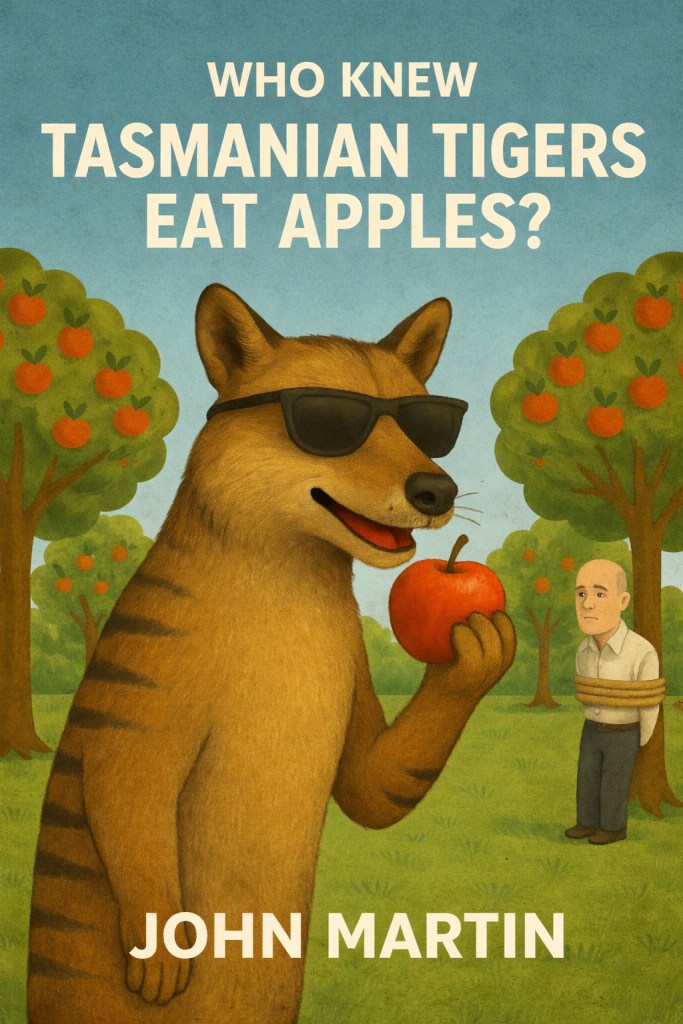
Enjoying this free preview? You can find the ebook on Amazon, Kobo, Apple Books or Barnes & Noble. If you prefer the smell of paper and ink, the paperbacks are on Amazon too.
 JOHN MARTIN'S TALES