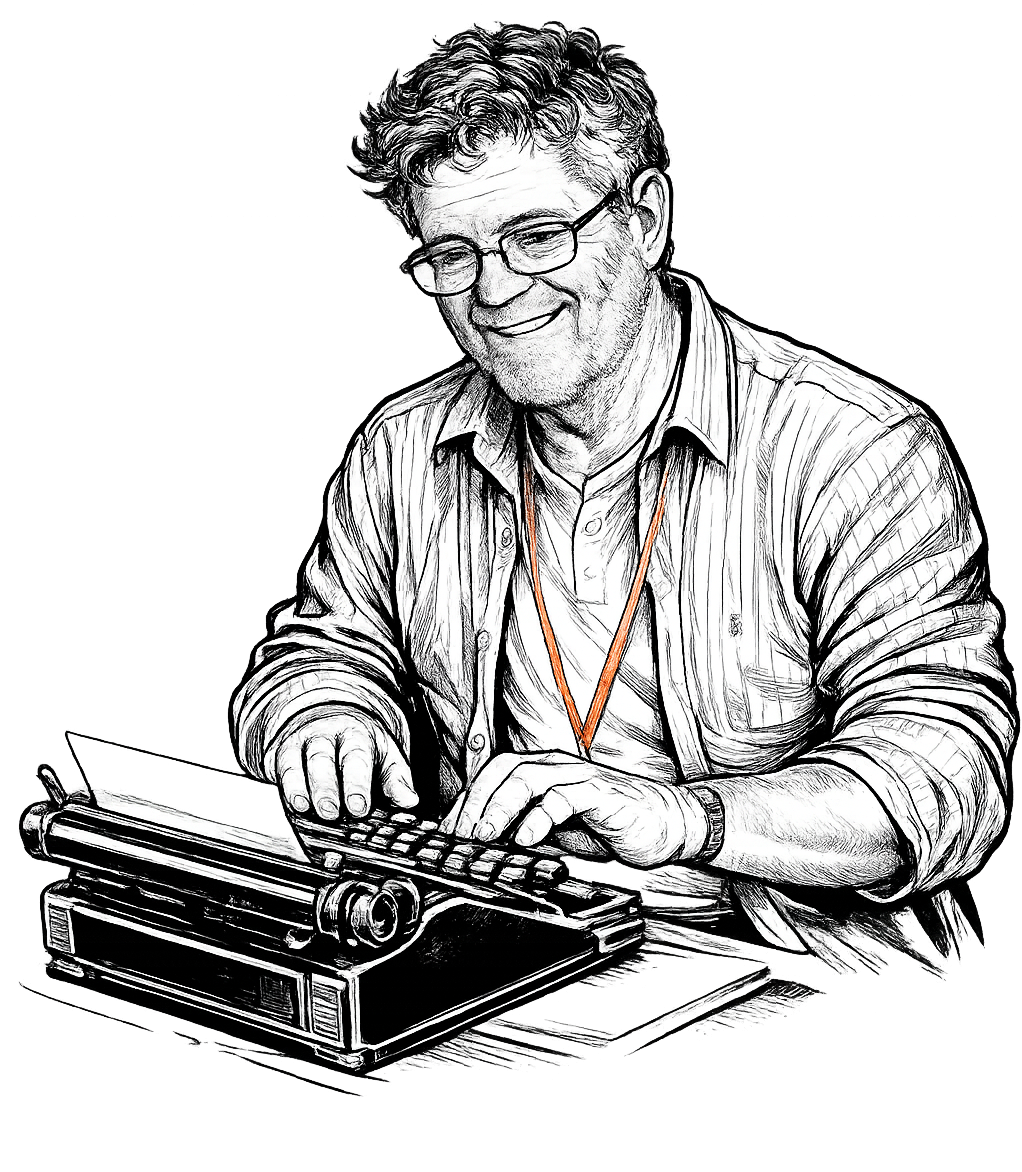
I felt like Moses receiving the Ten Commandments when I was given my very first newspaper stylebook.
I DIDN’T SAY I LOOKED LIKE HIM.
The Bible never says what Moses was wearing on the mountain or describe his attire when he came down.
Exodus (34:29) only says that his face shone and that he was carrying two stone tablets.
The best guess we have about his wardrobe comes from Hollywood. Charlton Heston in The Ten Commandments wore a red and black striped cloak — very memorable but completely invented.
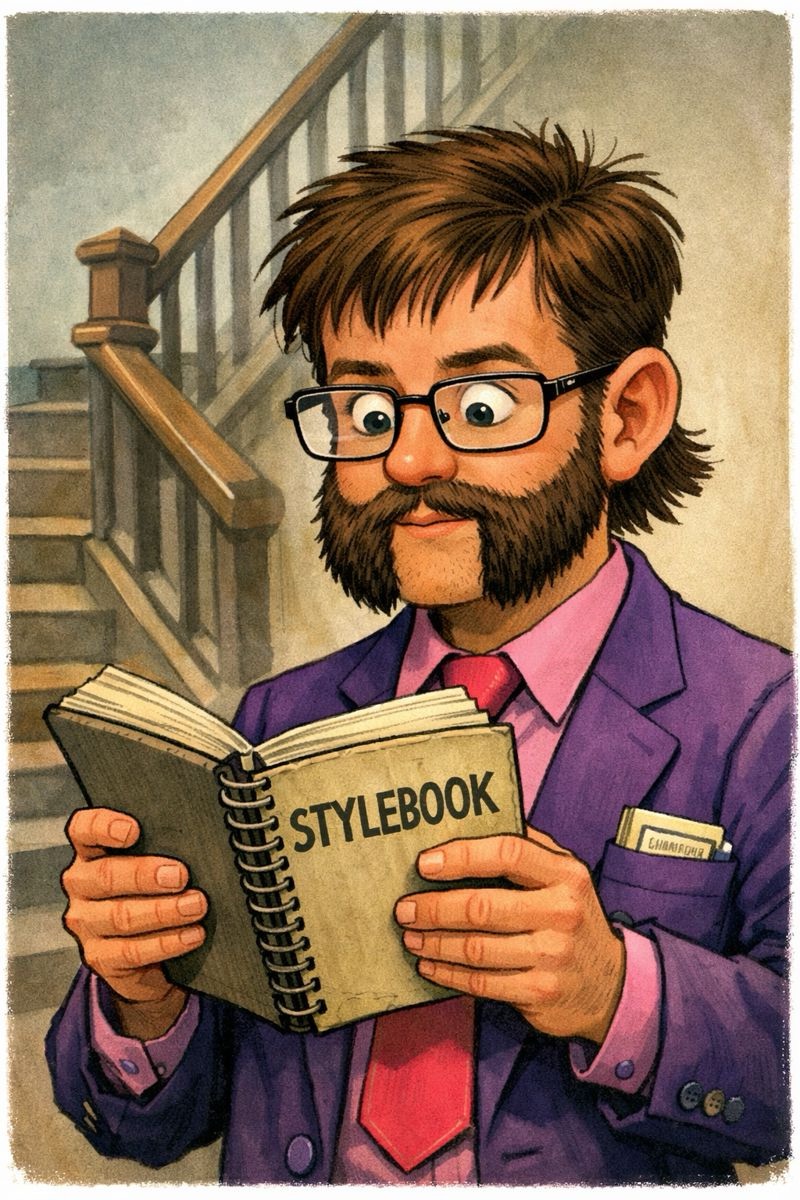
What we do know is that he was unlikely to have been wearing a purple suit and a pink tie, which is exactly what I was wearing when I started my working life on Monday, October 26, 1976.
At 2.26pm, I trotted up the back steps of The Examiner with the beginnings of a big, bushy beard.
(I can explain. Just as a forest starts with one tree, a big, bushy beard starts with one strong whisker. At barely 18, that’s all I had to offer. The luxuriant whisker towered above the fluff under my right ear and I called it Elvis.)
I should also point out that we don’t actually know if Moses even had a beard.
He’s certainly been depicted as hirsute in sculptures and paintings for the past 1600 years.
And to be fair, Middle Eastern men of that period didn’t shave unless they were priests or Egyptians.
So a beard is historically plausible — but its size and shape are pure imagination.
I also can’t rule out that he might have been given an electric beard trimmer for, er, Christmas and was sporting what I like to call The Red Sea Split — full beard, precisely parted down the middle. Left side goes left, right side goes right.
But back to Elvis and me.
At 10.30 that night, after a mentally exhausting initial shift, we descended from the first floor of the newspaper offices holding a hallowed copy of the house stylebook.
History doesn’t record whether my face shone.
Thinking back, my eyes must have looked glazed. So many things to learn, so many new faces I’d struggle to match with names.
Who exactly was that man in the grey suit who gave me the stylebook and told me to take it home, read it and memorise every word?
A stylebook is basically the paper’s rulebook, designed so that everyone marches, if not to the same beat, at least in the same direction.
Every reporter used to get a copy. It showed how to spell troublesome words consistently: only one t in benefited; on to — two words, always; into — one word, usually; under way — two words unless you’re talking about a ship. And why say something “got under way” anyway when a single word like start or begin does the job in nearly half the time?
The stylebook advised how to refer to people with titles, how to structure stories, and it included one classic example of the kind of writing the paper expected everyone to match.
It was an actual report of an Anzac Day dawn service, written by a legendary former reporter.
Now, Launceston has good reason to be proud of its dawn services.
Most Australian towns didn’t lock in a regular dawn service until the 1930s, but Lonny was holding pre-sunrise ceremonies in the early 1920s, when many mainland services were still simple indoor gatherings or mid-morning parades.
One distinctive Launceston feature was the use of buglers placed on high points around the city. For several years, buglers were positioned on:
- church towers in the city centre;
- balconies of civic buildings;
- occasionally the rooftop of the Albert Hall.
Their Last Posts drifted across the dark streets, echoing down Charles Street and over Princes Square. People would stop where they were — and stand in silence.
By the time of the story reproduced in the stylebook, I think the dawn service had been shifted to Royal Park and the multiple buglers were a thing of the past.
The story reproduced in the stylebook was still an evocative colour piece.
No quotes.
Just narrative that put you right there at the gathering: the smell of rum, the clip-clop of boots on stone, the lowering of the flag, the haunting shrill of a lone bugle. Mates honouring mates.
It was some years later, though, that I found out the legendary reporter had slept in and made the entire story up — using memories of all the dawn services he hadn’t missed over the years.
So next time I embellish a story, know this: I learned from a legend.


Leave a comment