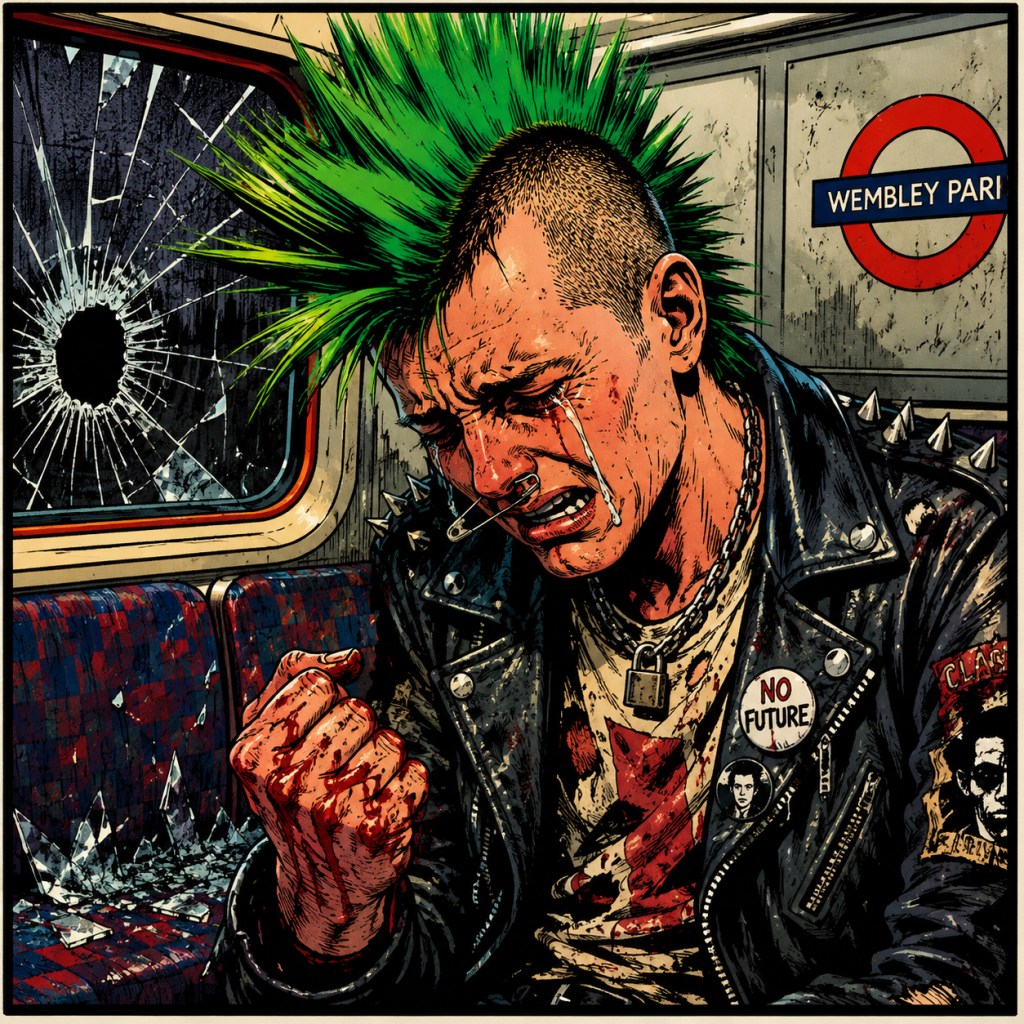
The punk with the green mohawk and a safety pin through his nose examined his bloodied knuckles, then started sobbing.
He had just smashed the thick window beside him on a London Tube in 1980.
Broken glass was everywhere. Over his leather jacket. Over the seat. Over the floor.
And I was the only witness — though I wasn’t brave enough to say so at the time.
Let me explain why.
In 1980, I lived in Karwyn House, a huge share place in South London. Think of the house from The Young Ones, add another 30 or so young people, and you’re nearly there.
Despite this, we were quite cultured — if you can call drinking culture, culture.
The cultural event of our year was a team drinking contest up the road at the Chestnut Hotel. Twelve players on each side. The Burpers versus The Farters. We were young and immature, OK?
We did have other outings.
I was part of a group from the house went to The Roxy cinema in Brixton to see The Great Rock ’n’ Roll Swindle, the movie about the Sex Pistols.
By 1980, punk in London had changed from the first explosive wave of 1976–77 into something rougher, more political and quite visible on the streets.
Britain was economically battered. There was high unemployment, strikes, urban decay and tension under the newly elected government of Margaret Thatcher. Many young people genuinely felt there was no future for them — which had been one of punk’s original slogans.
The first-wave giants like the Sex Pistols had largely imploded by then, but bands like The Clash, The Damned and Siouxsie and the Banshees had come to the fore.
But here’s the thing I know now that I didn’t know then — and had I known it, I might have made different decisions.
Punks hung around Tube stations.
Why? Because punk was performative. Part of the point was being seen.
Tube stations were brightly lit, crowded and public.
Before mobile phones, people arranged to meet at obvious landmarks: “outside the station”, “under the clock” or “top of the escalator”.
I didn’t know it then but our worlds were about to collide.
I did lots of jobs during my time in London. I had trained as a journalist, but I wanted a break from trying to be serious. So I took temporary jobs as a messenger and dishwasher. I was qualified for both. I had played a lot of Monopoly and knew my way around Old Kent Road, Fleet Street, Piccadilly, all the railway stations and Chance. I had also dirtied a lot of plates.
But when I saw legendary Tasmanian cyclist Danny Clark was competing in the London Six Day at Wembley Arena, I sensed an opportunity to write a feature story I might be able to sell back home in Tasmania.
Now here’s the thing that still confuses me today.
While we had no trouble finding 24 volunteers for The Burpers versus The Farters, I couldn’t find one person prepared to make the trek to the other side of London for six nights in a row to watch a cycling race.
That is how I came to be the only person in Carriage C on the Jubilee line, heading home from Wembley about 11pm, when the Tube stopped at a station and the punk with the green mohawk came aboard.
He looked at me, then took a seat quite close by.
Next came the explosion of glass.
Moments later, a guard burst through the door.
He looked at the punk with the bloodied fist.
Then he looked at me.
“Did you do this?”
I kid you not.
“No,” I protested.
“Well, did you see who did?”
This is where I considered my options.
A punk who could do that much damage to thick glass could probably make an even bigger mess of my head.
So I said I saw nothing.
I just wish the guard had asked me why the punk had done it.
I now suspect the punk’s so-called mates had told him to meet them in Carriage C when they knew perfectly well they were actually travelling in Carriage F.
No wonder he was crying.


Leave a Reply