History is full of doctors and scientists who believed the quickest way to test a theory was on themselves.
It sounds reckless today, but many regarded it as the ultimate proof of conviction. If they weren’t prepared to risk their own lives, why should anyone else?
Australian doctor Barry Marshall famously swallowed Helicobacter pylori bacteria in 1984 to prove that stomach ulcers were caused by infection rather than stress.
He made himself thoroughly ill, proved his point and eventually received a Nobel Prize.
More than half a century earlier, German doctor Werner Forssmann threaded a catheter through a vein in his own arm and into his heart because nobody would let him try the procedure on a patient.
I have always felt my own contribution to medical science has been rather unfairly overlooked.
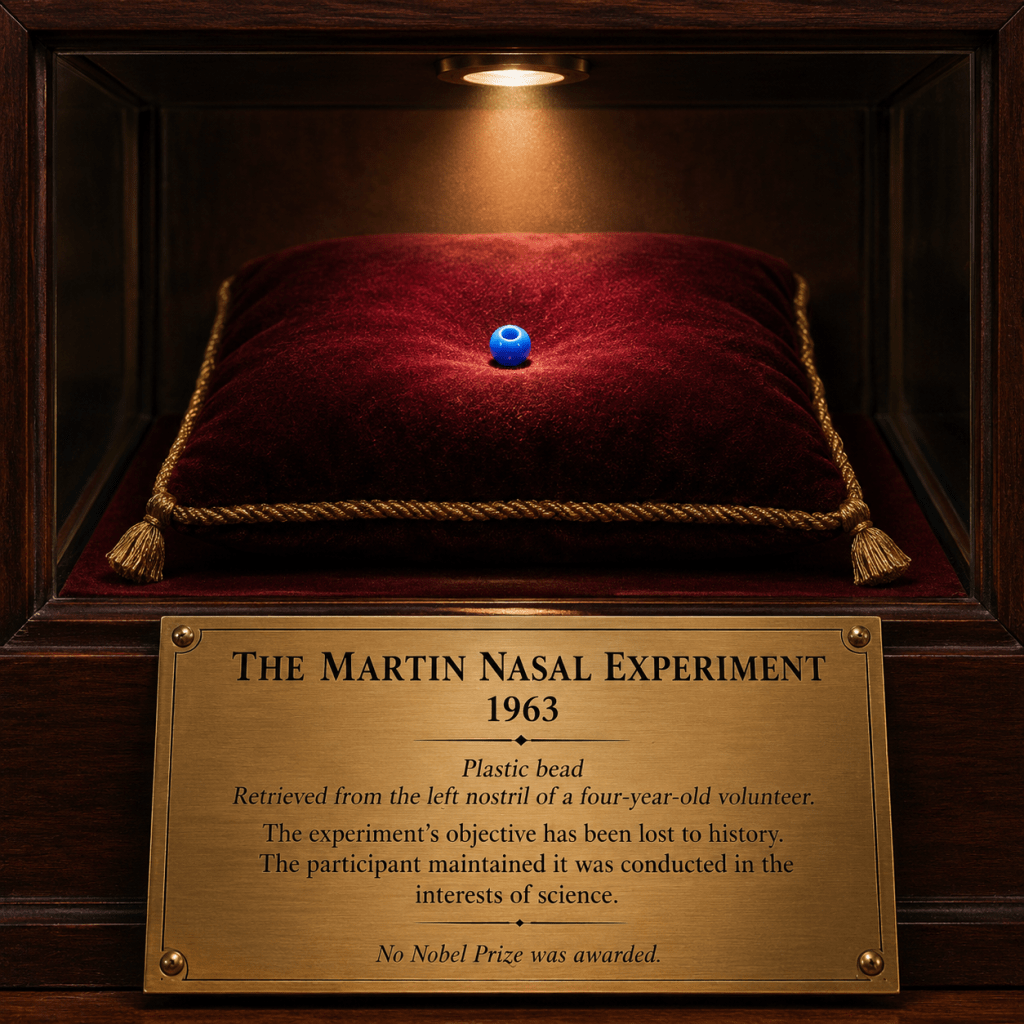
In 1963 I inserted a bead as far as I could into my left nostril.
I have absolutely no recollection why. Perhaps I was investigating the aerodynamic properties of plastic jewellery. Perhaps I wanted to discover whether the average human nose had a carrying capacity greater than previously suspected.
Or perhaps I was simply four years old.
Whatever the motivation, I remember the conclusion. A doctor produced what appeared to be a pair of long steel pinchers and inserted them into my nostril in pursuit of the missing bead. It was an experience I wouldn’t recommend to anyone contemplating a career in scientific research.
Some people have cruelly suggested this incident was an early sign that I wasn’t destined to become a high achiever.
I maintain I was conducting research. The fact that my methodology was questionable and my results impossible to reproduce should not diminish the achievement.
Besides, who knows? That doctor might have gone on to do great things.
Every specialist has a first unusual case. If he later became Australia’s leading authority on objects lodged in children’s noses, I’d like to think I gave his career a gentle nudge.
The episode certainly seems to have influenced my mother. For several years she confidently predicted that I would grow up to become a doctor.
One Christmas Santa arrived with a little white medical case emblazoned with a bright red cross.
Inside was a toy stethoscope and several plastic medical instruments. I can’t remember what the others were, but surely one of them should have been a miniature plastic bead extractor.
Sadly, medicine and I drifted apart. My complete lack of talent for mathematics and science eventually forced Mum to reconsider.
Without any formal announcement, she simply changed my career path. From then on I was going to be a writer instead.
In hindsight, she probably made the right diagnosis. I never became the sort of doctor who writes up medical case histories. I became the sort of writer who waits 63 years before writing one.
Footnote: Self-experimentation doesn’t always end well. In Peru in 1885, medical student Daniel Carrión deliberately infected himself with a deadly disease in the hope of solving a medical mystery. He succeeded. He also died. By comparison, stuffing a bead up my nose turned out to be a comparatively low-risk research project.


Leave a Reply